Blushing Blooms


Blushing Blooms
Kamille Corry has made art for as long as she can remember. Its enthusiasms and inspirations are her gravitational force, the star she follows. As a child she drew everything, even copying from photographs. She loved the act of drawing itself; people were her subject of choice, both their figures and faces. “I love creating the illusion of a form taking up space, the solidity of it. It is why I do realistic-style painting,” she says. From youth she hungered to develop her skills more deeply and learn all the artistic modes of expression. Her parents encouraged her and provided her with special art classes.
Art studies at her hometown University of Utah followed, but abstraction and pop art were the era’s focus. The basic tenets of form, composition, and color were discarded in favor of freeform experimentation, which left Corry frustrated and dissatisfied. She left school and traveled to Italy, where in the city of Florence she found ateliers teaching traditional etching and printmaking plus drawing and painting. She also found classical artist and teacher Jeffrey Mims, who became her mentor. After several years with him, she followed Mims back to his school in North Carolina. She went on to teach art herself, first giving private instruction and later establishing a small school for figurative art. When the Covid pandemic made models difficult to come by, she turned to her landscaped garden as an accessible and inspiring subject. “When I look at nature, I keep striving to capture how beautiful it is to me, and want to keep going and going,” she says. Her flowers are a marvel, full of vibrant color and energy, both painterly and vividly alive.
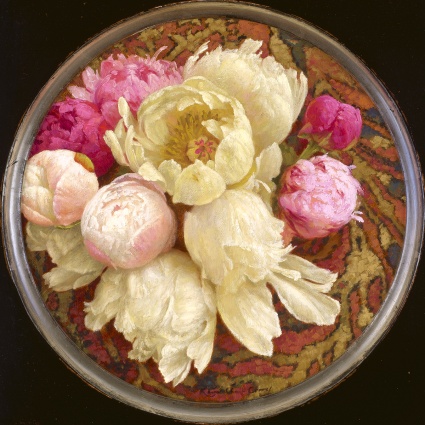
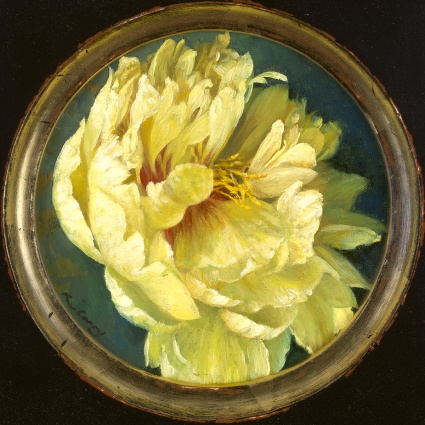
Corry has a special attraction to peonies and paints them in multiple variations. Recently she has adopted the tondo format for a series of delicate portraits of these flowers. The tondo, or round painting was popularized in Renaissance Italy and adopted by many of artists of that time. In Blush Peony and Itoh Peony ‘Barzella’ (both 2025), Corry creates tender portraits of solitary blossoms, but in May Peonies (2025), she sets out a whole bouquet on a Turkish-style carpet. The circular bird’s-eye view gives access to every subtle variation of color and form. From bright pink buds whose overlapping petals fit together in neat little packages, to white and cream examples with their feathery petals unfurled, each nuance of form and color is expertly captured by her brush. Even in passages thick with pigment, her peonies retain their essential delicacy.
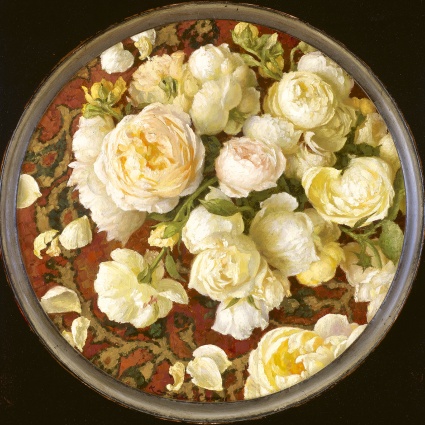
In Garden Roses (2025), a similar circular composition of abundant flowers—roses this time—rest on another patterned carpet. Small buds mix with lush mature blooms along with a few dry and scattered petals. As in May Peonies, Corry’s exceptional brushwork highlights the contrasting textures of the luxuriant man-made rug and the lovely but all too ephemeral blooms.
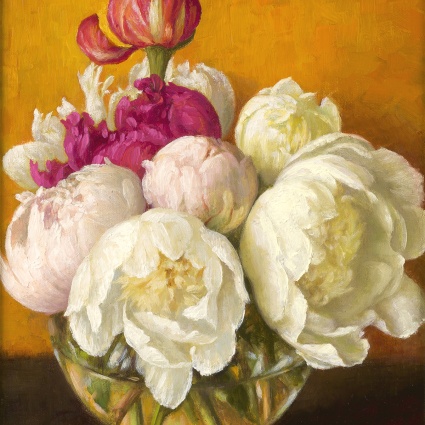
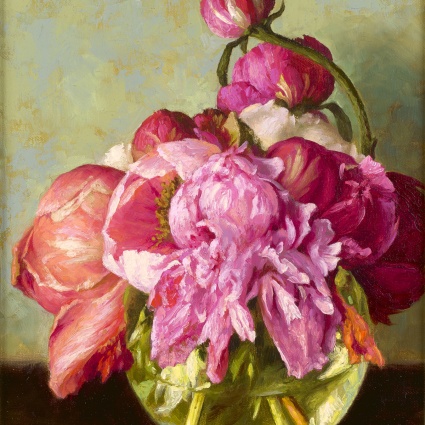
Returning to the rectangle format Corry creates a more traditional presentation in Coral Peonies with Glass Bowl (2025). An abundant bouquet of the flowers rests in a vase in a familiar still-life arrangement. Low afternoon light shines through an unseen window, picking out the flowers and the mottled wall behind them and sending its sparkles through the contrasting yellow-green glass vase. Each bloom strikes a variation on pink or coral, some marked by cream or white, others deepening into crimson, their various moods and aspects coming to life through Corry’s rich applications of creamy pigment.
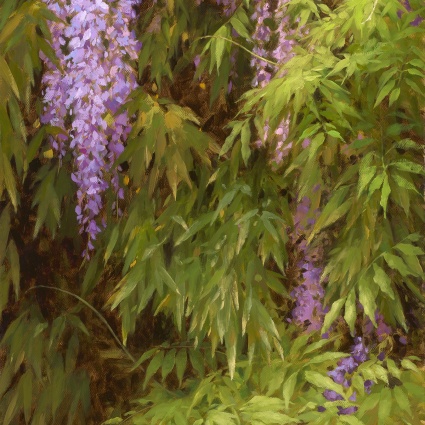
In a surprising departure from intimate peonies and roses, Corry changes direction with a climbing wisteria vine and tall bamboo, choosing a format more than four feet high and almost two feet wide to accentuate their growing habits and wisteria’s cascading blooms. A transportive painting, Wisteria with Bamboo (2025), carves out a piece of the garden and brings it to life. Large trailing blooms in a range of purples surrounded with slender bright green leaves and tendrils fill the painting’s surface from top to bottom. A few small breaks in the foliage reveals bits of sky above, and the layers of multi-toned greens break up the light as it travels through. The painting is not so much a subject as it is a surrounding, and an entrance into a fragrant sunlit world.
Throughout the years Corry has returned to Italy, annually if possible. She stays in a 15th century villa outside of Florence that now caters primarily to working artists, where she can store her materials and paint in the surrounding gardens daily. “It’s more challenging to paint from life,” she says. “It keeps me engaged, and I like to see how it changes as I go.” Clearly, she has a strong connection to this Renaissance-infused culture, which has always nourished her and has imbued her art with its unmistakable aura.

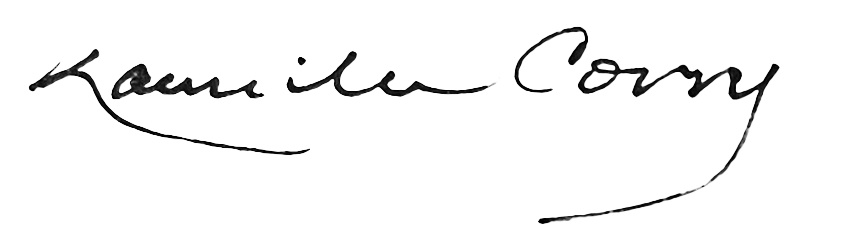
Kamille Corry
Corry’s paintings reflect her classical training and fine craftsmanship, while rendering the figure in a modern, provocative light.